Showing posts with label Dreamweaver. Show all posts

Adobe Creative Suite 4 Design Premium Digital Classroom


Aquent Creative Team, "Adobe Creative Suite 4 Design Premium Digital Classroom"
Wiley | 2009 | ISBN: 047047842X | 816 pages | PDF | 33 MB

Full-color book and instructional DVD form a complete training package for Adobe CS4 Design Premium

Written by a team of Adobe certified instructors, this complete training package helps you learn to use the market-leading design and development suite at your own speed. The book includes 26 lessons that let you discover essential skills and explore the new features of Adobe CS4 Design Premium. Each lesson includes step-by-step instructions and lesson files, supplemented with video tutorials on the DVD. Each lesson in the book has a supplementary, five-minute video lesson that demonstrates and explains the concepts and features covered in the book.

You'll also explore integration techniques that can be implemented using Adobe Bridge and Version Cue, the file management and collaboration tools found in Design Premium.

* Full color, step-by-step instruction makes learning even complicated tasks less intimidating, while the video training demonstrates each task
* Covers InDesign, Illustrator, Photoshop, Acrobat, Dreamweaver, Flash, and Fireworks
* You set the pace, learning at your own speed
* Written by the same team of Adobe Certified Instructors and Creative Suite experts who have created many of the official training guides for Adobe Systems
* Includes 26 lessons designed to teach you all aspects of the most popular design and development suite for print, Web, and mobile media

Adobe Creative Suite 4 Design Premium Digital Classroom is like having your own personal instructor guiding you through each lesson at your convenience.

Download:
Link

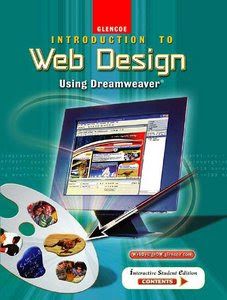
Introduction to Web Design Using Dreamweaver


Introduction to Web Design Using Dreamweaver® provides students with step-by-step activities that teach the skills needed to plan and create Web sites.

Download:
Link

Sams Teach Yourself Dreamweaver UltraDev 4 in 21 Days


Sams Teach Yourself Dreamweaver UltraDev 4 in 21 Days teaches you all the skills you need to get up and running effectively with Dreamweaver UltraDev 4. The tutorial approach aids you in learning the basics quickly and then moves on to the more advanced features and concepts. By the end of the 21 days, you will know how to create dynamic Web sites containing database interactivity, streamline ASP content, write custom validations and extend functionality with JavaScript, design enhanced navigation of the Web site, and incorporate interactivity. Written by leading trainer and developer John Ray, you will benefit from expert tips for more effective site design.

Download:
Link_1

Sams Teach Yourself Macromedia Dreamweaver 4 in 24 Hours

Sams Teach Yourself Macromedia Dreamweaver in 24 Hours shows Web developers and designers how to use Macromedia's powerful Web development tool to create sophisticated Web sites. Written by Betsy Bruce, an authorized trainer who has taught Dreamweaver to thousands of beginning students, the book does not dwell on elementary Web page authoring techniques, but focuses more on intermediate-level Web development topics like building dynamic Web sites, creating image maps and interactive forms, designing animations, setting up frames, and adding interactivity. This edition of the book has been thoroughly revised and updated to cover all the new features of the latest version of Dreamweaver.

Download:
Link

Dreamweaver 8 Design and Construction - Web production methods from the master architect builders


Part 1: Planning Your Site
You don't construct a building without a blueprint, and you don't build a web site without a plan. These chapters take you through the planning process with an eye toward maximizing design and production.

Chapter 1, Stocking Your Technological Toolbox
Chapter 2, Staking Your Claim
Chapter 3, Organizing The Content
Chapter 4, Sketching the Interface
Chapter 5, Preparing Images for the Web
Chapter 6, Thinking About Text
Chapter 7, Setting Up Your Site

Part 2: Designing Your Site
With your plan in hand, you create a Dreamweaver template to control the layout of your pages, plus an external Cascading Style Sheet to control the look and feel of the content. By the end of this part, the pages of your site are rolling out your studio.

Chapter 8, Opening a New Page
Chapter 9, Designing with Tables
Chapter 10, Designing with Layers
Chapter 11, Creating Templates
Chapter 12, Building a Stylesheet

Part 3: Building Your Site
Into the rough template-based pages go the navigation, the text, the images, the Flash movies, the links, and the forms that you've been planning since Part 1. By now, production is unstoppable. Each new addition to the template document fleshes out your site in a wonderful way.

Chapter 13, Adding a Navigation Bar
Chapter 14, Adding Text
Chapter 15, Adding Images
Chapter 16, Adding Flash Content
Chapter 17, Connecting Links
Chapter 18, Building Forms

Part 4: Publishing Your Site
Before you realize it, your site is finished. Use Dreamweaver's site management features to check for broken links, orphaned files, and rogue code. Then upload your site to the Web, and learn how the design-build approach by way of Dreamweaver translates into effortless site maintenance.

Chapter 19, Tuning, Testing, and Troubleshooting
Chapter 20, Going Live

Download:
Link_1

Dreamweaver CS3 Classroom in a Book


1. Quick Start to Dreamweaver CS3
If you're new to Dreamweaver, your first question might be, "Where do I start?". The answer, in this book, is "right here." Take advantage of Dreamweaver's expertly designed starter pages to quickly create a standards-based layout, ready for your personalized content. Along the way, you'll explore how to work the Dreamweaver way and build a professional quality Web page.
2. Customizing your Workspace
Although building Web pages involves a fair degree of technical expertise , Web designers are, in their hearts, artists—and all artists work best in their own workspace. Dreamweaver offers a great number of avenues for customizing the design experience and focusing your creative energies.
3. Applying Cascading Style Sheets
Cascading Style Sheets (CSS) are the technology used by modern Web designers to provide a consistent look-and-feel across a site. Dreamweaver CS3 is a true CSS power tool with the ability to easily display, define, apply and modify styles for a variety of mediums, including: screen, print and handheld devices.
4. Working with Text
Much of the Web designer's world revolves around text: entering, styling, and updating all manner of words. The text tools in Dreamweaver are rich and varied. Enter headings and text with equal ease and quickly shift from one to the other. Add a numbered or bulleted list to stress key points. Bring in a table of data either manually or imported from an external source. Whichever type of text element you choose, Dreamweaver gives voice to your words.
5. Designing with Images
There can be no doubt that the Web is a highly visual medium. Dreamweaver provides a great number of ways to work with graphics, both within the program itself and with other dedicated graphic authoring tools, including Adobe Fireworks CS3 and Adobe Photoshop CS3. Adobe Bridge CS3 ties all the applications together to give you the power to explore your visual dreams.
6. Inserting Links
In some ways the Web is, at its heart, a collection of links. Within any given site, links provide a conduit to quickly navigate from one related topic to another. A link from one site to another can span vast distances with a single click. Links serve other functions as well, bringing up email messages for an interactive response or within an individual page to target a specific page area. Dreamweaver handles all of these link variations with straightforward ease and flexibility.
7. Crafting Page Layouts
The Cascading Style Sheet (CSS) revolution continues to solidify its foothold in the Web designer community. Modern Web design techniques demand a structured, standards-compliant CSS-based layout– and Dreamweaver is happy to deliver. Dreamweaver renders CSS standards impeccably to help Web designers like yourself meet the challenges of building layouts through styles. Even better, Dreamweaver includes additional layout tools, such as rulers and guides, to help you shape your stylistic visions into real-world layouts.
8. Creating Interactive Pages
What brings a Web page to life? Interactivity. Rollover an image to see another larger image appear instantly, click a link to open a new browser window with additional information or load a page to watch a freshly added section glow momentarily to attract your attention. All of these examples of interactivity are easily accomplished with Dreamweaver behaviors—and, better still, quickly tailored to custom-fit your new, lively Web page.
9. Integrating Ajax with Spry
Welcome to the world of Web 2.0. Here, portions of pages are updated with XML data—without reloading the entire page. Here, content on a page is hidden or revealed at the click of a mouse button. Here, sophisticated eff ects highlight a designated area automatically when the page is loaded—and disappear without further interaction. Dreamweaver CS3 brings you Web 2.0 power with a full range of easy-to-use tools to control the Adobe Ajax framework, Spry.

Download:
Link_1

The ESSENTIAL Guide TO The Essential Guide to Dreamweaver CS3 with CSS, Ajax, and PHP

Chapters 1 and 2 serve as an overview of the whole book, explaining what’s new and what has changed in Dreamweaver CS3. Chapter 2 also explains in detail how to use Spry effects. They are simple to apply and don’t require knowledge of CSS or PHP. If you’re new to Dreamweaver, these chapters help you find your way around essential aspects of the Dreamweaver interface.
Chapters 3 and 4 show you how to set up your work environment for PHP and Dreamweaver. If you already have a local testing environment for PHP, you can skip most of the material in these chapters. However, I urge you to follow the instructions at the end of Chapter 3 to check your PHP configuration. The section in Chapter 4 about defining your testing server in Dreamweaver is also essential reading. These two subjects are the most frequent causes of problems. A few minutes checking that you have set up everything correctly will save a lot of heartache later.
Chapters 5 and 6 cover in depth how Dreamweaver handles CSS. If you’re relatively new to CSS, Chapter 5 shows you how not to use Dreamweaver to create style rules. For more advanced readers, it provides a useful overview of the various CSS management tools, including the ability to reorder the cascade and move rules to different style sheets without ever leaving Design view. Chapter 6 uses one of the 32 built-in CSS layouts to create an elegant site, and in the process, unravels the mysteries of the CSS Styles panel.
Chapters 7 and 8 return to Spry, exploring the Spry Menu Bar and the tabbed panels, accordion, and collapsible panel user interface widgets. Because these widgets make extensive use of CSS, you’ll find these chapters easier to follow if you’re up to speed on the previous two chapters. Of course, if you’re already a CSS whiz kid, jump right in.
Chapter 9 sees the start of practical PHP coverage, showing you how to construct an online form. The second half of the chapter completes the roundup of Spry widgets, showing you how to use Spry to check user input before a form is submitted. This is client-side validation like you’ve never seen before. If you want to concentrate on PHP, you can skip the second half of the chapter and come back to it later.
As noted earlier, Chapter 10 is a crash course in PHP. I have put everything together in a single chapter so that it serves as a useful quick reference later. If you’re new to PHP, just skim the first paragraph or so of each section to get a feel for the language and come back to it later to check on specific points.
Chapters 11 and 12 give you hands-on practice with PHP, building the script to process the form created in Chapter 9. Newcomers to PHP should take these chapters slowly. Although you don’t need to become a top-level programmer to use PHP in Dreamweaver, an understanding of the fundamentals is vital unless you’re happy being limited to very basic dynamic pages. If you’re in a hurry, you can use the finished mail-processing script from Chapter 12. It should work with most online forms, but you won’t be able to customize it to your own needs if you don’t understand how it works. Chapter 12 also looks at using Dreamweaver templates in a PHP site.
Chapter 13 gets you ready to bring out Dreamweaver’s big guns by guiding you through the installation of the MySQL database and a graphic interface called phpMyAdmin. This chapter also covers database backup and transferring a database to another server.
Chapters 14 through 17 show you how to build database-driven web pages using PHP, MySQL, and Dreamweaver’s PHP server behaviors. You’ll also learn the basics of SQL (Structured Query Language), the language used to communicate with all major relational databases. To get the most out of this section, you need to have a good understanding of the material in the first half of Chapter 9. You’ll learn how to create your own content management
system, password protect sensitive parts of your site, and build search forms.
The final three chapters (18–20) introduce you to working with XML (Extensible Markup Language), the platform-neutral way of presenting information in a structured manner. XML is often used for news feeds, so Chapter 18 sets the ball rolling by showing you how to use Dreamweaver’s XSL Transformation server behavior to draw news items from a remote site and incorporate them in a web page.
Chapter 19 explains how to generate a Spry data set from XML and use it to create an online photo gallery. The attraction of Spry is that it provides a seamless user experience by refreshing only those parts of a page that change, without reloading the whole page. The disadvantage is that, like most Ajax solutions, the underlying code leaves no content for search engines to index, or for the browser to display if JavaScript is disabled. So, Chapter 20 shows how to get the best of both worlds by creating the basic functionality with PHP and enhancing it with Spry. The final chapter also shows you how to generate your own XML documents from content stored in your database.

Download:
Link_1

Foundation Web Design with Dreamweaver 8 - Craig Grannell

Chapter 1 A NEW KIND OF WEB DESIGN
In this chapter, you’ve learned about how the Internet came to be, and also many important things you need to do before working with Dreamweaver. You’ve also read overviews on XHTML and CSS—technologies that will prove essential as you work your way through the book.

Chapter 2 GETTING STARTED WITH DREAMWEAVER
In this chapter, we'll take a look at Dreamweaver itself, so you can learn how to create a new document and you can familiarize yourself with the application’s interface.

Chapter 3 SETTING UP A WEBSITE
In this chapter, you will learn how to set up a site and how to work with files in Dreamweaver’s Files panel. It’s a good idea to experiment with the various options, and with uploading and downloading files, to get comfortable with file management—you’ll be doing a lot of this when you start working on a live site.

Chapter 4 WEB PAGE ESSENTIALS
This chapter covers the background you’ll need to create web pages—the essential components of web pages and sites, including all the “behind the scenes” elements that are so important when creating successful pages.

Chapter 5 WORKING WITH TEXT
In this chapter you’ve learned how to work with website text, ensuring that it’s structurally sound and logically marked-up, and that it looks good.

Chapter 6 WORKING WITH IMAGES
In this chapter, you’ve learned how to approach using images on your web pages, found out about the different image formats available, discovered various means of adding images to pages and editing them in Dreamweaver, and you also now know a number of ways to style them using CSS.

Chapter 7 CREATING NAVIGATION FOR YOUR WEBSITE
In this chapter, we’ll explore the main area of web page interactivity, by looking at how to create navigation for your websites.

Chapter 8 WEB PAGE LAYOUTS
The next chapter is the final piece in learning how to create the bulk of website pages—you’ve already learned about typography, images, links, and navigation, so now it’s time to deal with general web page layout, so you can position on the screen all the elements you’ve learned how to create so far.

Chapter 9 GETTING USER FEEDBACK
This chapter takes a look at getting user feedback by creating website forms that a user can fill in and submit to contact you.

Chapter 10 PUTTING IT ALL INTO PRACTICE
In Chapter 10, you’ll see how to take various elements from the chapters in this book and combine them into effective web page layouts.

Download:
Link_1

Blog Archive

hit

hit counters
 
Related Posts Plugin for WordPress, Blogger...